
Beer restaurant on Myasnitskaya street - " Lambic"

Beer restaurant on Myasnitskaya - Lambic Brasserie: its appearance became necessary, because the popularity of Belgian beer is growing at an enviable rate. Sometimes, especially on weekends, not all true connoisseurs of beer can taste it in "Lambic" restaurant on Vorontsovoye Pole - all seats are occupied.
Muscovites appreciate the exquisite taste of two traditional classes of products produced by Belgian brewers:
- first-class classic lager beers ;
- a line of special beers: monk beer, cherry beer, Trappist ale, unfiltered ale, Belgian ale, seasonal beer and other beers that create a unique brand of "Belgian beer".
We have done everything to satisfy the needs of our customers: a wide range of fresh draft and bottled Belgian beer, diverse and truly delicious appetizers, soups, steaks, grills... Traditionally cozy interior of our restaurants will in no small measure contribute to your excellent rest after the working day and at weekends!
It's easy to find our restaurant on Myasnitskaya: it is located near Chistye Prudy and Turgenevskaya metro, and only five hundred meters from Krasnye Vorota metro.
Know that:
You go to a beer restaurant from Chistye Prudy metro - from Chistye Prudy metro to "Lambic" restaurant 2 minutes by foot.You go to a beer restaurant from Turgenevskaya metro - from Turgenevskaya metro to "Lambic" restaurant 2 minutes.You need a beer restaurant on Chistoprudny Boulevard - from Chistoprudny Boulevard to the restaurant on Myasnitskaya - 2 minutes. If you want to find a beer restaurant near Krasnye Vorota metro station - from Krasnye Vorota metro station to the beer restaurant it takes 9 minutes to walk.After visiting the restaurant you can walk to Chistye Prudy - it will take you only 10 minutes.
Lambic - beer and restaurant on Myasnitskaya
The extensive selection of exquisite Belgian beers at Lambic, a restaurant near Chistye Ponds, is something we're particularly proud of.
So let's talk about beer. Not about the one that is bad for our health, but about the one that pleases us at certain moments of our lives - about Belgian beer.
Beer is classified not only by color (as a rule in Russia, Ukraine and also in some European countries), but also by the way of fermentation.
In this classification two kinds of beer are distinguished:
- Ales are fermented at 15-25 °C with top fermenting yeast. It often has a fruity flavor, and the alcohol content is usually high. It takes 3 to 4 weeks (rarely up to 4 months) to brew an ale.
We offer the following on draft: Delirium Tremens, Pauwel Kwawk, Belhaven McCallums Stout, Triple Karmeliet, MARTINS PALE ALE, Bourgogne des Flandres, Leffe Blonde, Palm or Special Belge.
- Lager is the most common type of beer. The production technology is as follows: yeast is added to the brewed and cooled beer wort and pumped into the tank. For about a week the fermentation process takes place at a temperature that excludes oxidation. In the next stage the yeast is separated and the beer is sent for secondary fermentation. The fermentation and maturation of the beer at low temperature lasts from 20 to 120 days, sometimes more. At the end, the beer is filtered and poured into barrels, bottles and cans. Bottled beer is often pasteurized or finely filtered to extend its shelf life.
A number of beers do not fall under such classification, and they are allocated to separate types:
- Wheat beer - differs in that the method of bottle fermentation is used to make the beer.
- Lambic - belongs to a special class - Belgian beer of spontaneous fermentation. No beer yeast is used in the production of lambic - and this is its main difference from other types of beer.
Lambic is only made during the cool season, from October 15 to May 15 (in summer the fermentation rate becomes uncontrollable). The brewing hop, which determines the flavor and aroma of the beer, is a perennial plant. Its sticky grains on the underside of the leafs form the basis for the wort. The gummy kernels osmolate during storage and change their color and composition. They contain aromatic and bittering substances which to a large extent determine the taste, color and aroma of the beer. Lambic hops have to mature for at least three years in order for their aroma and bitterness to fade and diminish. Brewer's malt is made by germinating cereals (barley). Barley malt with ungerminated wheat grains is used for lambic. The malt is poured into wine casks which were previously used for maturing the wine. Fermentation is started and maintained by the so-called wild yeast which remains on the walls of the barrels. The main fermentation lasts for a week, and then the beer is aged for several more years.
Young lambic, aged from three months to a year, hardly foams and has a very sour taste.
Lambic is the basis for several excellent beers:
- Kriek or cherry lambic (Kriek, lambic with cherries added during the premarpening process, which lasts four to eight months, then filtered, clarified and bottled to full maturity for another year. Once bottled it reaches full maturity for another year, with a specific almond flavour and a five-year shelf life).
- Framboise (frambozen lambic) (add raspberries before the ripening).
- Faro, a peculiar blend of light and strong lambic beers; caramel and sugar - white or brown - are added to the wort before fermentation in order to give it the necessary color; the taste is sweet and sour, with a subtle hop bitterness)
- Gueuze Lambic (Gueuze, a blend of young one-year-old Lambic with more mature two- and three-year-old varieties; it is prematured with residual sugar in the young Lambic; it is slightly sour, but the taste is more balanced than that of young or old Lambic alone)
- Oude goise is an old lambic, 1/3/5/10 years old.
Do you already want to taste these delightful drinks? Come to the restaurant "Lambic" on Myasnitskaya! We're waiting for you!



Wine Tasting on 5 November On 5 November at 20:00, Lambic Collection will host a private tasting organised by the Collection wine club, featuring six sparkling wines. The term “blanc de blancs” has long evolved beyond a description of colour (“white from whites”) to represent a distinctive style that sets these wines apart. During the tasting, we will explore their character and unique qualities, discovering just how delicious, vibrant and food-friendly they can be. — 2025 Chiarli Vecchia Modena Brut Millesimato Blanc de Blancs — NV Codorniu Anna de Codorniu Blanc de Blanc — NV Champagne Georges Clement Louis Armand Brut — NV Champagne Grand Cru Bonnet Gilmert La Reserve Brut — NV Champagne Grand Cru Marcel Moineaux Boheme Extra-Brut — 2018 Champagne Grand Cru Marcel Moineaux Cuvee Virtuose Brut Ticket price per person: 6,900 ₽ Guest arrival: 19:30 Dinner starts: 20:00 Spaces are limited, with seating at a shared table. You can purchase an e-ticket at Lambic Collection or on our delivery website. To purchase an e-ticket:1) Add an e-ticket to your basket on the delivery website 2) Enter any delivery address at checkout 3) After payment, a restaurant manager will contact you within a day to confirm the details
28 October 2026
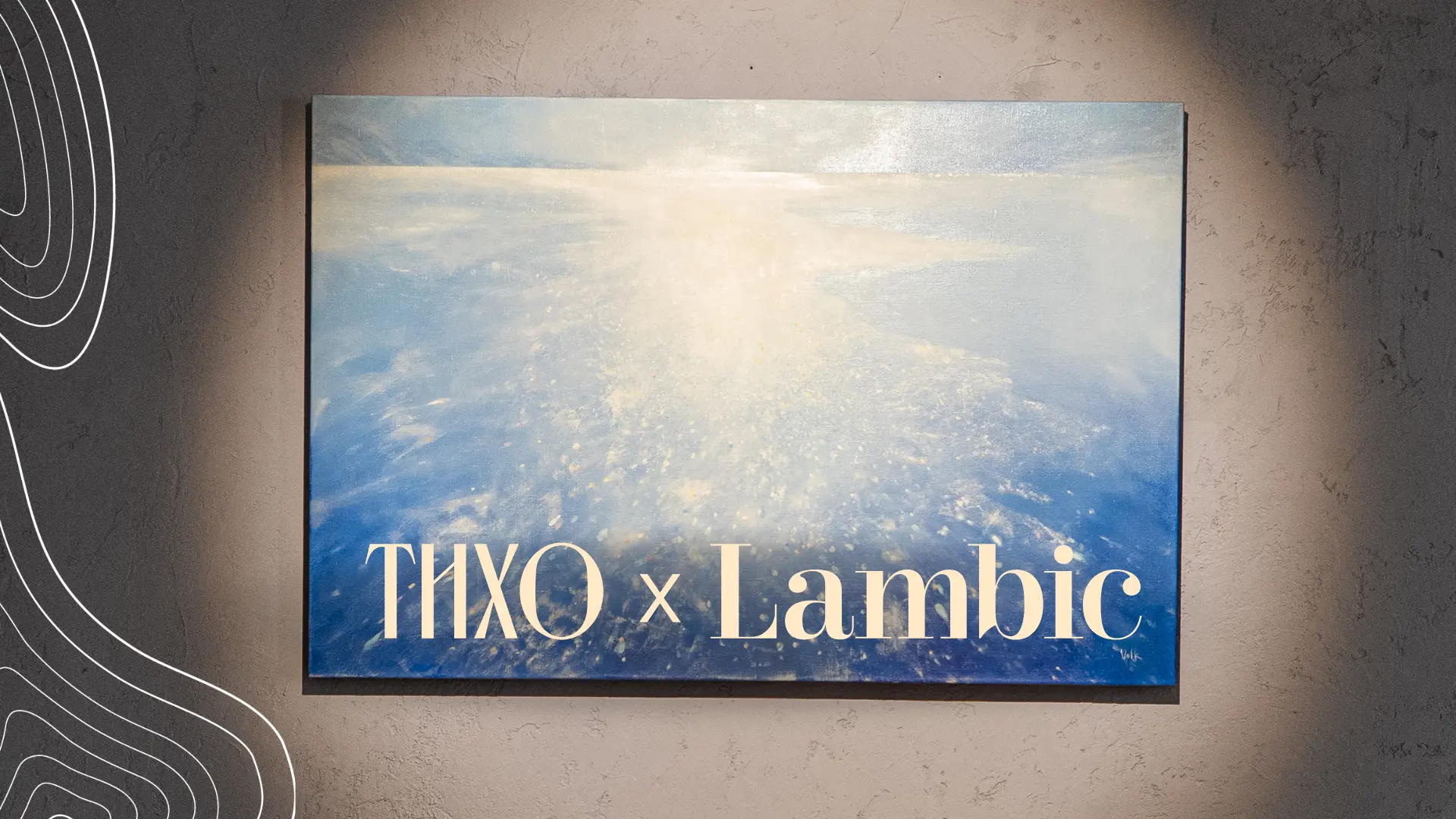
Lambic continues to introduce you to contemporary art. In collaboration with TIKHO Gallery, we present “Common Places”, an exhibition at Lambic, 33/1 Gogolevsky Boulevard. “Common Places” brings together three female artists who draw on recognisable motifs from nature to express their subjective experiences. Through an intuitive use of colour and texture, semi-abstract imagery shaped by emotion, and personal symbolism, the artists create images that feel both familiar and elusive. “Common Places” invites us to reflect on how personal our memories truly are, and why an image of a completely unfamiliar place can sometimes evoke the feeling of coming home. TIKHO Gallery — an independent gallery founded by Irina and Yan Tikhonenko — is located in a historic 19th-century mansion in Moscow’s Chistye Prudy neighbourhood.
28 October 2026